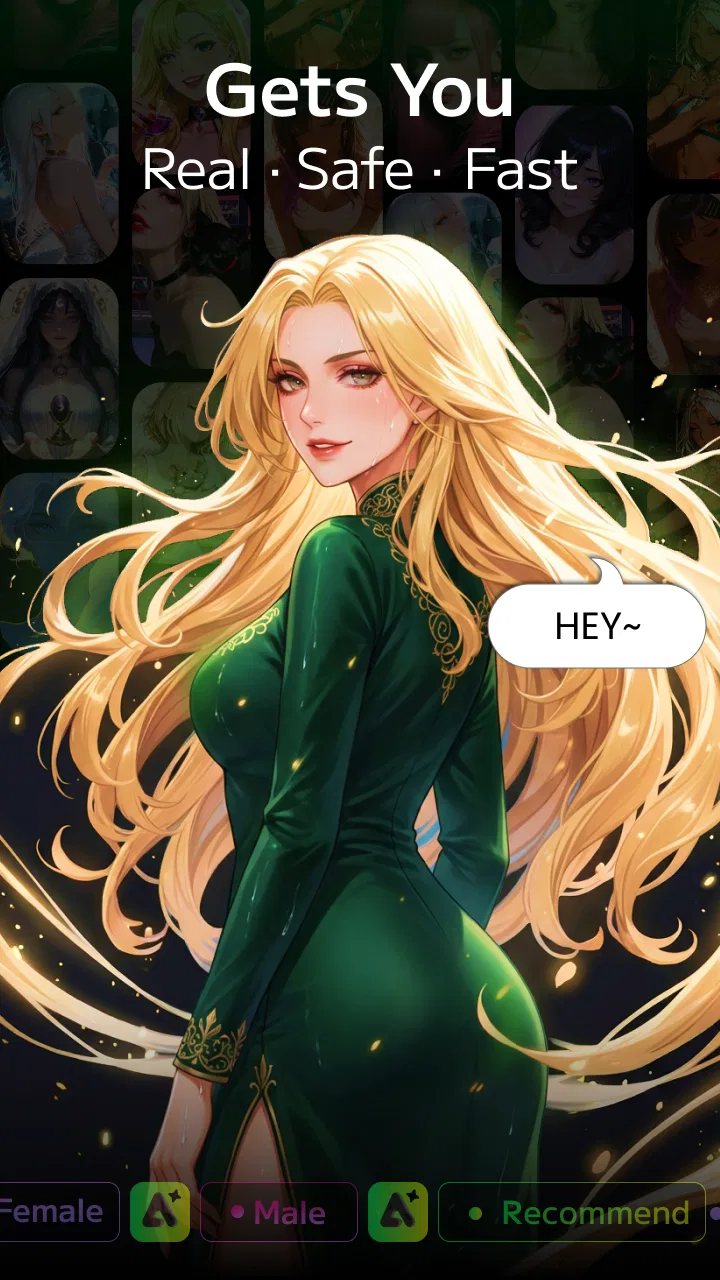
AllureGF: AI Romance Chat
- 4.6
- Rating
- 100.00K
- Installs
- Free
- Price

 Analysis by App-foxy
I approached AllureGF: AI Romance Chat as an entertainment app rather than a replacement for real relationships, and that distinction matters from the first conversation. Created by Scrumlab Tecnologia, it lets me create AI characters and explore romantic-style chats in a private, low-pressure setting. The appeal is easy to understand: I can choose the tone of an interaction, experiment with different personalities, and return to a conversation whenever I want without arranging anything with another person.
My overall impression is that this is best viewed as a flexible role-play and companionship experience. It can be relaxing after a long day, useful for playful storytelling, or simply interesting for anyone curious about conversational AI with a romantic angle. At the same time, it is not the right choice for someone looking for factual answers, human intimacy, or a fully predictable script. The quality of the experience depends heavily on how clearly I shape a character and how comfortable I am with an interaction that is generated rather than genuinely felt.
How the current experience feels
The central loop is straightforward: create an AI character, begin chatting, and guide the relationship-style conversation through my replies. That simplicity is one of the app’s strengths. I do not need to learn a complicated interface or manage a large set of entertainment modes before reaching the main attraction. The focus stays on the exchange itself, which makes short sessions easy to start.
You May Also Like

 Blood Strike: 2.5 Anniversary
Blood Strike’s Loadouts Turn Every Drop Into a Tactical Gamble
A close look at Blood Strike’s custom loadouts: how fast access to signature weapons reshapes its battle royale rhythm, rewards preparation, and narrows the gap between fights.

 Pandora - Music & Podcasts
Pandora’s Music Is Easy to Start, but Harder to Recover
Pandora’s strength is its low-effort path from a seed to a station. Its weak spot is how much confidence it asks you to place in connection, setup, and quiet recovery.

 8 Ball Pool
 Is Built on Rivalries, Rematches, and Routine
A close look at the rivalries, rematches, shared routines, and unanswered safety questions that turn a quick pool match into a persistent mobile community.

 Samsung Music
’s Quiet Strength Is Playing What You Already Own
Its reach comes less from spectacle than from dependable access to a personal library. That simplicity is both the app’s strongest retention engine and its ceiling.

 AccuWeather: Weather Radar
AccuWeather Review: A Quick, Clear Forecast for Everyday Decisions
For everyday plans, the best forecast is the one you can understand quickly. AccuWeather makes rain timing, radar, and local conditions easy to act on, with a few trade-offs.

 Hill Climb Racing
Why Hill Climb Racing Still Turns Crashes Into One More Run
A tiny car, a bumpy hill and one more upgrade: Hill Climb Racing keeps resurfacing because its simple chaos makes every near-miss feel personal.
More From Our News Desk
View All News


I found the character-creation idea more important than the romantic label alone. A predefined chatbot can become repetitive because every user receives essentially the same personality. Here, the opportunity to shape a character gives the conversation a more personal starting point. I can decide whether I want a gentle, teasing, dramatic, or imaginative tone, then use my messages to reinforce that direction. The better I establish the mood early, the more coherent the experience feels.
That also creates a useful distinction between casual and committed use. If I only want a few amusing messages, I can treat the app like a quick diversion. If I want an ongoing fictional relationship, I need to pay attention to the character’s identity and keep my own replies consistent. In practice, this makes the app less like a passive video and more like an interactive story that changes according to my input.
The entertainment category fits it well because the value comes from participation. I am not just consuming a finished romance plot; I am helping direct one. That can be surprisingly engaging when the conversation catches a rhythm. It can also feel less satisfying when the replies drift away from the personality I had in mind. I would not install it expecting every exchange to feel equally natural.
Who will get the most from it
I think the strongest audience is adults who enjoy character-driven role-play, improvised fiction, and conversational experiments. Someone who likes writing scenes but does not always have a partner available may appreciate having a responsive character to play against. The app can also suit users who prefer a private way to explore romantic dialogue without the pressure of messaging a real person.
A realistic everyday use case would be a quiet evening when I want something more interactive than scrolling through short videos. I could create a character with a particular personality, begin with a simple scenario, and spend a few minutes building a playful conversation. Another day, I might use the same idea as a writing warm-up: establish a character, test how the dialogue develops, and note which responses suggest a stronger fictional direction.
That workflow is more useful than treating every message as a search for emotional reassurance. The app works better when I arrive with an idea, a mood, or a scene to explore. A small prompt such as a setting, a shared history, or a conversational boundary can give the character more shape than a series of vague greetings. This is one of the less obvious lessons of using a customizable AI companion: the user’s preparation strongly affects the result.
I would recommend skipping it if the main goal is meeting real people, building a mutual relationship, or receiving dependable advice. The app can imitate warmth and attention, but it does not create a human connection. It is also a poor fit for anyone who dislikes improvisation or wants every response to remain perfectly consistent. For those users, a traditional romance game with authored dialogue may be more satisfying because its characters follow a designed narrative rather than generating replies on the fly.
Building a better character
The most practical way to improve the experience is to treat character creation like writing a compact brief. Instead of defining only an appearance or a broad romantic mood, I would give the character a clear conversational identity: how direct they are, what subjects they enjoy, whether they tease or reassure, and what kind of pace feels natural. Even without turning the setup into a long document, those choices help me recognize when the conversation is staying on track.
I also found that starting with a situation works better than opening with a generic greeting. A scene gives the exchange something to respond to. For example, I might begin with two characters meeting after an awkward first date, planning a surprise, or discussing a shared fictional hobby. This creates immediate context and reduces the chance that the conversation becomes a sequence of empty compliments.
Another useful habit is to correct the direction early. If the character becomes too serious, too familiar, or too generic, I can state the preferred tone directly instead of waiting for the interaction to recover on its own. That may feel less romantic for a moment, but it usually produces a better role-play session afterward. In my experience, conversational AI responds more usefully when I give it a clear adjustment than when I send several frustrated messages.
For longer sessions, I would keep a simple mental summary of the fictional relationship. Important details such as a shared plan, a favorite activity, or the reason the characters met can anchor later messages. This is a practical trade-off: the app makes creation easy, but the user may need to provide some continuity. Anyone expecting the character to carry an elaborate story without occasional reminders may find the experience uneven.
What the current release means for users
The current version is 1.5.0, and the app’s release date is April 24, 2026. Those details place the review in a specific moment: this is an experience that should be judged by what is available now, not by assumptions about where AI companions may go next. I see the version information as a useful marker for existing users who want to know whether they are evaluating the same stage of the product as someone else.
For a new user, the practical takeaway is simple: install it with realistic expectations and spend time testing the character-creation process before deciding whether the conversational style suits you. For someone already using an earlier build, the sensible approach is to notice whether the current release changes the feel of character setup, chat flow, or general reliability during normal use. I would not assume that a version number alone guarantees a dramatic transformation; the meaningful question is whether the day-to-day interaction feels more comfortable for your particular style of use.
The app has attracted an average rating of 4.6 from around 6.6 thousand ratings, with more than 300 written reviews and over 100 thousand installs. That level of interest suggests that the concept is reaching a real audience, but it should not be read as a promise that every conversation will work equally well. Ratings are especially personal for an app like this because one user may value playful fantasy while another may judge the same behavior as repetitive or artificial.
Existing users should also think about how their expectations have changed. A person who originally wanted a novelty chat may eventually want deeper continuity, more varied scenarios, or stronger control over tone. Those are different needs from simply having an AI character available. The current release can be enjoyable for open-ended interaction, but I would evaluate it session by session rather than assuming that a favorite character will automatically remain compelling forever.
Where it differs from familiar alternatives
Compared with ordinary messaging apps, this experience removes the need to find a conversation partner and wait for a reply. That makes it more convenient for private experimentation, but it also removes genuine reciprocity. A real person can surprise me with an independent point of view, change their mind, or bring experiences I could never script. AllureGF offers responsiveness on demand, yet the interaction remains generated within the boundaries of an AI role-play.
Compared with dating apps, the purpose is different. Dating platforms are built around discovering and communicating with real users, while this app is centered on creating fictional AI characters. Someone hoping to move from chat to an actual relationship should choose a dating service instead. Someone who wants to rehearse dialogue, explore a fantasy scenario, or enjoy a controllable companion may prefer this format because there is no need to manage profiles, matches, or social uncertainty.
Compared with a conventional romance game, the main trade-off is authorship. A story-led game can deliver polished scenes, carefully timed reveals, and dependable character arcs. This app offers more freedom because I influence the conversation directly, but that freedom can produce less dramatic structure. I would choose the app for improvisation and choose a narrative game when I want a complete romance plot with a clear beginning and ending.
It also differs from a general-purpose AI assistant. A productivity chatbot is usually judged by accuracy, organization, and task completion. This app is judged by atmosphere, character consistency, and conversational chemistry. Trying to use it as an authoritative source would miss its purpose. Its strength is imaginative exchange, not research or professional guidance.
Costs, age suitability, and personal boundaries
The app is free to install, while optional in-app purchases range from $2.99 to $54.99 per item. I would approach those purchases carefully and decide what value I am actually getting from extended use before spending money. A free starting point makes experimentation accessible, but the presence of paid items means I would check the purchase screen closely and avoid paying simply because a conversation has become emotionally engaging.
The mature 17+ rating is important, especially for households where several people share a device. I would treat that label as a clear signal that the app is intended for older users and not as a casual children’s chat toy. Adults should still set their own boundaries around the kinds of scenarios they want to explore. The ability to create romantic-style conversations can make the experience feel personal, so it helps to decide in advance which subjects and tones are comfortable.
My strongest advice is to keep the fictional nature of the interaction visible. Enjoying a character does not mean the character has feelings, intentions, or a life outside the conversation. That reminder is not meant to spoil the experience; it makes the experience healthier and easier to control. If I notice that I am relying on the app for every emotional need, avoiding real-world contact, or spending more than intended, I would step away and reconsider how I am using it.
Privacy-minded users should apply the same care they would use with any conversational service. I would avoid entering identifying information, private secrets, financial details, or messages that I would not want associated with an online account. Even when a chat feels intimate, the safest habit is to keep the fictional scenario separate from sensitive personal data.
Remaining friction in everyday use
The biggest limitation is inherent to the format: generated conversation can lose continuity. A character may feel convincing in one exchange and less distinctive in the next. That is not necessarily a defect in one particular message; it is a reason to keep expectations flexible. If the emotional tone or story detail matters greatly, I would restate the key context rather than assuming that the app will preserve every nuance.
Romantic-style dialogue can also become repetitive when I use the same opening pattern repeatedly. The solution is not always a new character. Sometimes changing the scenario, introducing a small conflict, or asking the character to make a decision creates more energy than starting another generic conversation. This is a useful trade-off: the app gives me creative control, but I have to use that control to avoid predictable exchanges.
There is a difference between customization and control. Creating a character can establish a direction, but it does not mean I can dictate every response. Users who want strict scripts, exact wording, or a guaranteed emotional progression may become frustrated. For them, an authored interactive novel or a conventional game is likely a better purchase, even if it offers less conversational freedom.
I would also avoid judging the app after only one short chat. The concept depends on finding a character style and scenario that fit the user. A rushed test with no context may make the experience seem flat, while a carefully framed session can reveal more of its entertainment value. That does not mean every weakness disappears with effort; it simply means the app rewards a little experimentation before reaching a final opinion.
What I would watch as the product develops
For future use, I would pay attention to how consistently characters maintain their personalities across separate sessions. That matters more to me than adding decorative choices. A companion that remembers the tone and fictional history I care about would feel more useful than one with many superficial customization options but weak continuity.
I would also watch for improvements in conversation variety. The best development path would preserve the easy entry point while giving experienced users better ways to create distinct scenarios, adjust boundaries, and recover when a chat drifts. Those improvements would benefit both newcomers who want a quick interaction and long-term users who need a reason to return.
Another point worth monitoring is the balance between free access and paid features. The free starting experience is important because it lets me decide whether the app’s style suits me. Optional purchases make more sense when they support a clear, understandable benefit rather than encouraging impulsive spending during an emotionally charged conversation. I would want that value to remain easy to judge.
Finally, I would watch whether the app continues to present itself as entertainment rather than implying that an AI character can replace human relationships. That framing protects the user and clarifies the product’s role. The strongest version of this idea is not one that tries to imitate real life perfectly; it is one that gives me a creative, controllable space for fictional conversation while keeping the boundaries clear.
My final view is favorable, with sensible limits. AllureGF: AI Romance Chat is worth trying if you enjoy interactive character work, romantic role-play, and short entertainment sessions shaped by your own prompts. I especially like the freedom to create a character instead of being locked into one fixed personality. The experience becomes more rewarding when I provide a setting, correct the tone early, and treat continuity as something I help maintain.
I would not recommend it as a dating service, a source of serious advice, or a substitute for real companionship. The mature audience, optional purchases, and unpredictable nature of generated dialogue all deserve attention before regular use. For the right person, though, this is an approachable way to explore fictional intimacy and conversational storytelling. My advice is to start free, protect personal information, set a spending limit, and judge the app by whether it gives you enjoyable interactions rather than by how closely it resembles a human relationship.
FAQs for AllureGF: AI Romance Chat
01What is AllureGF: AI Romance Chat?
AllureGF: AI Romance Chat is an AI-powered companion app designed for romantic and casual conversations. After choosing or creating a virtual character, you can chat with the AI, explore different conversation scenarios, and receive responses shaped by the character’s personality. It is intended for entertainment and companionship, not as a replacement for real relationships, professional counseling, or genuine human interaction.
02How does the AI companion in AllureGF respond to messages?
The app generates replies using artificial intelligence and the context of your conversation. Responses can feel personalized, but they may occasionally be repetitive, inaccurate, inconsistent, or unlike what a real person would say. The experience depends on the character selected, your prompts, and the app’s available features. Users should treat the conversations as simulated entertainment rather than evidence of real emotions or consciousness.
03Is AllureGF: AI Romance Chat free to use?
AllureGF may allow users to download the app and access some introductory features without payment, while additional messages, characters, customization options, or premium content may require in-app purchases or a subscription. Pricing, limits, and available plans can change, so it is important to review the current store listing and subscription terms before confirming payment. Also check renewal and cancellation conditions carefully.
04Is AllureGF safe and private for personal conversations?
Before using AllureGF, review its privacy policy and the permissions requested by the app. Conversations may be processed or stored to provide, maintain, or improve the service, depending on the developer’s practices. Avoid sharing passwords, financial details, precise location, private photographs, or other sensitive information. If the app includes mature or romantic content, users should also follow the applicable age requirements and platform guidelines.
05Who should use AllureGF, and what should users expect?
AllureGF is primarily aimed at adults or users who meet the age requirement shown on the relevant app store, particularly those interested in AI roleplay and virtual romantic companionship. You can expect interactive conversations and character-based scenarios, but not guaranteed emotional support, confidentiality, or consistently human-like behavior. If romantic themes, subscriptions, or simulated relationships are unsuitable for you, consider those factors before downloading.
Pros
- Offers personalized romantic conversations with an AI companion.
- Available anytime
- making it easy to chat whenever you need company.
- Can help users explore different conversation styles privately.
- Simple chat-based design is easy to understand and navigate.
- Provides an imaginative roleplay experience for romance fans.
Cons
- AI responses may sometimes feel repetitive or lack emotional depth.
- Romantic interactions can become less engaging without varied prompts.
- Some features or conversations may require in-app purchases.
- Privacy policies should be checked before sharing personal information.
- It should not replace genuine relationships or professional emotional support.

AllureGF: AI Romance Chat
Gallery